
Blogs
How a School Management System Simplifies Everyday School Operations
22 Sept 2026 • Read Time: 8 mins
There is a side of school management that parents and students rarely see. Before an attendance update reaches a parent, someone has recorded it. Before a fee reminder is sent, someone has checked the account. Before a principal reviews a report, information has usually been collected from different people and departments. Multiply those small activities across an entire school day, and the amount of coordination becomes considerable.
This is one reason schools are turning to a School Management System. The purpose is not merely to replace registers and spreadsheets. It is to give different teams a common place to manage the information they already work with every day.
When that information is organised properly, routine work starts taking fewer steps.
-
Why Is a School Management System Needed?
A school can function without a School Management System. Many have done so for years, but the difficulty begins as the institution becomes busier. One department maintains a spreadsheet while another keeps a register. A teacher has information in one application, while the accounts team maintains a different record. Important updates may then travel through email, messaging groups or phone calls. For a while, people manage because they know where everything is, but then someone goes on leave. A parent asks for an old record and a report is needed urgently. Suddenly, a task that should take a few minutes takes much longer. This is where centralising school information becomes valuable.
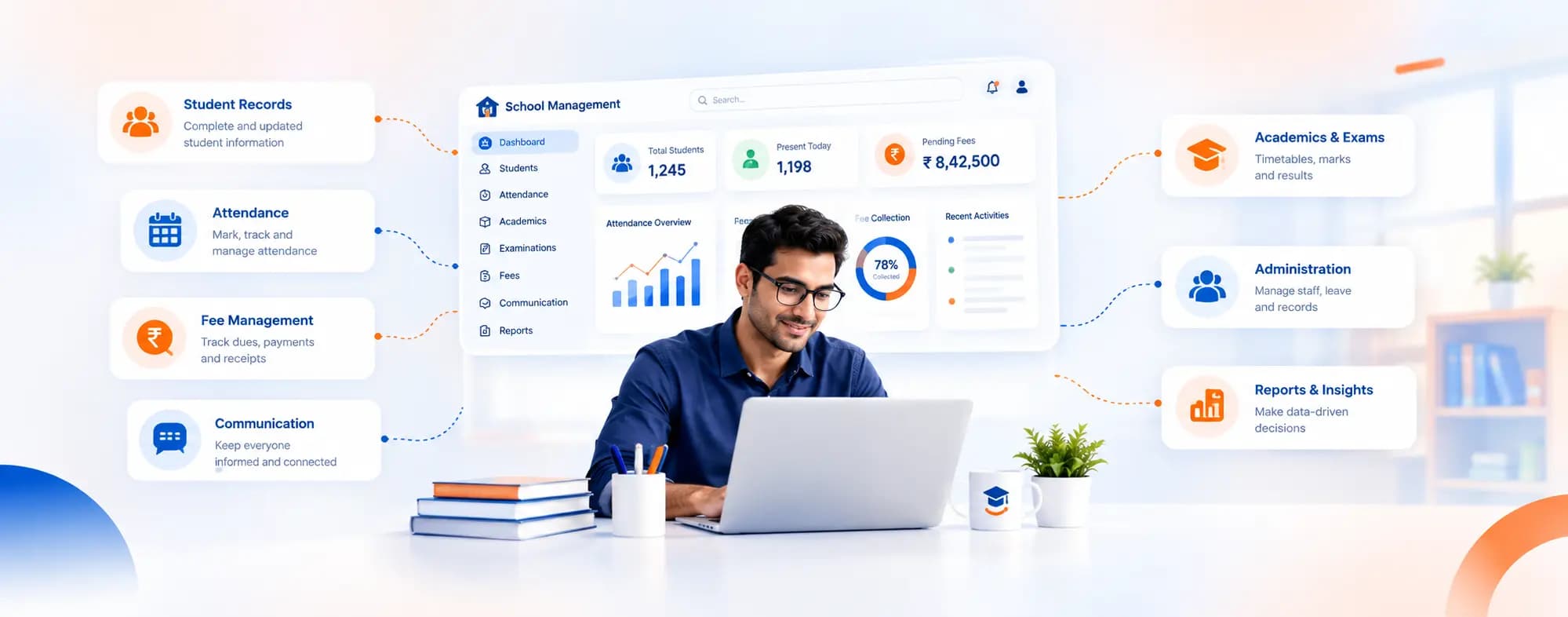
A School Management System can bring areas such as student records, attendance, academics, examinations, fees, administration and communication into a shared platform. Each team can work with the information it needs without having to maintain an entirely separate version of it. It also gives schools something that is easy to overlook: continuity.
The information does not remain dependent on one person's spreadsheet, one cupboard of files or one conversation in a messaging group.
-
How Does a School Management System Work?
The school sets up its structure in the system and maintains its core information there. Students are assigned to the relevant classes and sections, employees are added, academic details are configured, and other operational requirements are defined. After that, users carry out their normal work. A teacher records attendance while an administrator updates a student record.
The accounts team records a payment, while marks are entered after an examination. A school notice is sent to the relevant group, and each activity adds to the school's existing information rather than creating another isolated record. This is particularly useful when several departments depend on the same information. A student's record, for example, may be relevant to the academic team, administration and accounts department, although each team uses it for a different purpose.
The system can also restrict access according to responsibility. Teachers do not need access to every financial record, just as the accounts team does not need the teacher's entire academic workspace. Which makes the system practical for the people using it.
-
Where It Simplifies Everyday School Operations
Student records are easier to maintain
Student information appears in more places than most schools initially realise. It is needed during admission, class allocation, attendance, examinations, fee management, parent interactions and administrative work. When each department maintains its own version, inconsistencies are almost inevitable.
A central student record gives authorised users a common reference point. If information needs to be checked later, staff can find it without going through several unrelated files.
Attendance takes less administrative effort
Marking attendance is a daily responsibility for teachers, but maintaining attendance information does not have to create additional work for administrative staff. With digital attendance, records can remain available for reports and relevant parent communication without being copied from a physical register into another system.
It also gives schools a longer-term view of attendance instead of treating each day's register as an isolated record.
Fee management becomes easier to follow
Fee administration involves a surprisingly long chain of activities. There are fee structures to maintain, dues to track, payments to record, receipts to issue and reminders to send. When these activities happen across different records, the accounts team spends considerable time checking whether everything matches.
A connected fee management process keeps the relevant information together that helps schools see payment activity and pending amounts more clearly, while parents can access the information they need without relying entirely on the accounts office for routine queries.
Academic information stays in context
Academic work is also interconnected, like a timetable determines when a class takes place while attendance records who was present. Examinations produce marks, and those marks contribute to academic records and results. Managing each activity separately can create unnecessary duplication.
A School Management System allows these activities to sit within the same broader academic environment, giving teachers and administrators access to the information relevant to their work.
Communication becomes easier to manage
Schools communicate throughout the day, and not every message has the same purpose.
A fee reminder needs to reach the relevant parents, and an examination notice may concern a particular class. When communication is connected with school information, staff can work with the appropriate audience instead of repeatedly preparing lists and checking recipients.
SMS, email and application-based notifications can support different types of school communication depending on the requirement.
Reports do not have to begin with data collection
When management asks for an attendance summary or a fee collection report, someone should not have to start by gathering information from different departments. If the underlying records are already maintained digitally, reporting becomes a matter of reviewing information that is already there.
That can make a noticeable difference during busy periods when decisions need to be made quickly.
-
What Should Schools Look for in a School Management System?
A school should not select software simply because the feature list is longer.
The more useful question is: Will this make our existing work easier?
Before choosing a system, schools can look at:
- How easily teachers and staff can learn and use it
- Whether different modules share information where necessary
- How user permissions are managed
- Whether reports can be generated without repeated manual work
- Which communication channels are supported
- How school data is protected and backed up
- Whether the system can accommodate future changes
- How easily authorised users can access it outside the school office
A system that looks impressive in a demonstration but feels cumbersome during everyday use will eventually become another administrative burden.
Usability matters because school software is used repeatedly, often by people with very different responsibilities.
-
Frequently Asked Questions
What is a School Management System?
A School Management System is a digital platform that helps schools manage and connect academic, administrative, financial and communication activities.
Why do schools need a School Management System?
Schools use these systems to organise information, reduce repetitive administrative work, improve coordination between departments and make important records easier to access.
What can a School Management System manage?
Depending on the platform, it can cover student information, attendance, academics, examinations, admissions, administration, fees, employee records and communication.
How does a School Management System help teachers?
It can bring routine academic and classroom tasks such as attendance, examinations and timetable-related information into one workspace, reducing the need to manage the same information in multiple places.
Can a School Management System help with fee management?
Yes. School fee modules can support activities such as fee configuration, payment records, receipts, pending dues, reminders and collection reports.
Is a School Management System suitable for growing schools?
It can be particularly useful as a school grows because more students, staff and departments mean more information to coordinate. A suitable system should provide structure without making routine work unnecessarily complicated.
Is myMschool a School Management System?
Yes. myMschool brings academics, administration, finance, HR and communication together in an integrated school management platform. Its approach focuses on keeping everyday school operations organised and easier to manage.
Less Manual Work, Smoother School Operations
A school does not become better organised simply because it starts using software, but the difference comes from what the software removes from the daily routine.
Fewer spreadsheets to maintain, fewer records to reconcile, fewer messages asking another department for information, and fewer reports that have to be prepared from scratch.
The teachers, administrators, accounts teams, and school leaders still do the same essential work. They simply have a more connected way of doing it.
That is what a School Management System should ultimately provide: not technology for its own sake, but a clearer way to manage the everyday work that keeps a school running.
myMschool is built around that idea, bringing essential school operations into one intuitive platform so schools can spend less effort coordinating the system and more time managing the work itself.