
Blogs
How to Get the Most Out of Your School ERP - A Role-by-Role Guide
19 May 2026 • Read Time: 4 mins
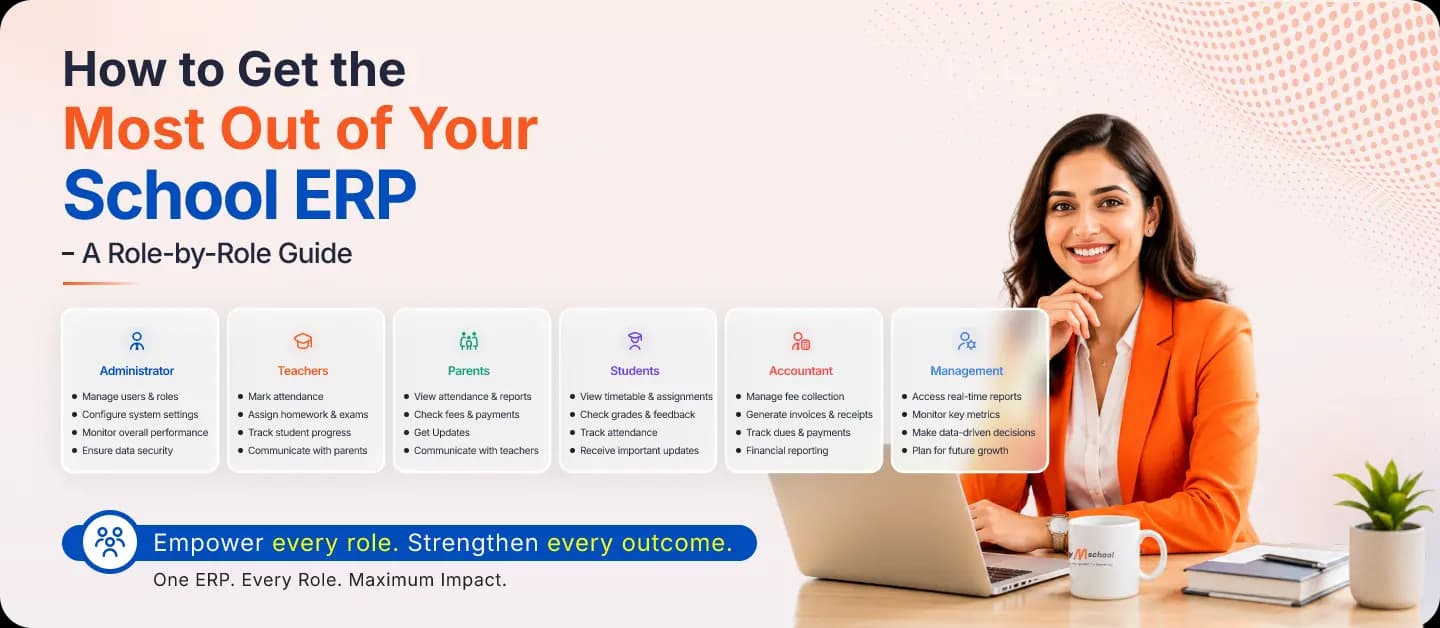
Implementing a school ERP is the starting line, not the finish. The schools that see the greatest operational improvement from their platform are the ones that go beyond initial setup and build habits around how each role engages with the system.
If your school has had an ERP for six months and it still feels like extra work rather than less work - this guide is for you.
-
For school owners and management: use the dashboard, not weekly reports
The biggest missed opportunity for school owners and trustees is the management dashboard. Most end up receiving weekly summaries compiled by someone else - which defeats the purpose of having real-time visibility.
Spend ten minutes at the start of each week reviewing three things directly in the platform: current fee collection status, attendance trends for the week, and admissions pipeline if the intake is active. These three data points, reviewed consistently, change how you run meetings and make decisions.
If your ERP doesn't make this easy - if getting to those numbers requires someone to run reports for you - that's a conversation to have with your vendor about dashboard configuration.
-
For principals: make the timetable and attendance your anchor
For academic leadership, the two modules that deliver the most day-to-day value are timetable management and attendance. When these are used consistently, substitution coordination becomes manageable, absenteeism trends become visible early, and the amount of time spent on daily logistical fire-fighting drops significantly.
One practical habit: check the attendance summary every morning before your first meeting. In five minutes, you'll know which classes have high absenteeism, which teachers are absent, and whether any students have crossed the threshold that requires a parent conversation. That kind of visibility, built into a daily routine, is where an ERP earns its cost.
-
For admin and front office teams: automate what you're still doing manually
Most administrative teams use their ERP for data storage but continue doing communication manually - sending individual fee reminders, calling parents about admissions, and compiling attendance reports by hand.
The first thing worth reviewing: which of your regular manual tasks could be triggered automatically by the system? Fee reminders are the most common example. If your ERP can send automated SMS and email reminders on the 5th of every month, and your team is still doing it manually, that's hours of recoverable time every month.
Map out the five most repetitive tasks your team does every week. For at least three of them, there's likely a workflow in your ERP that can handle it.
-
For teachers: keep it simple - attendance, assignments, marks
Teachers are the users most likely to avoid an ERP if it feels like extra work on top of an already full day. The goal is not to get teachers using every feature - it's to make the three things they do repeatedly faster and less error-prone.
Attendance marking should take two minutes per class. Assignment sharing should replace the WhatsApp group. Mark entry should replace the physical mark sheet. If those three workflows are running smoothly, everything else is secondary.
The school that gets the most from its ERP is the one that doesn't ask teachers to do more - it asks them to do the same things they already do, just inside the platform instead of outside it.
-
For finance teams: close the loop between reminders and collections
Finance teams tend to use fee management modules for tracking - but underuse the communication and reporting side. The result is a system that knows who hasn't paid, but still relies on manual calls and messages to follow up.
Build a monthly rhythm: automated reminders go out on the 1st. A defaulter report is reviewed on the 10th. A second automated reminder goes out on the 15th. Personal follow-up is reserved for accounts that haven't responded to either. This kind of structured cycle, run through the ERP, can improve fee collection rates meaningfully without adding staff time.
The one thing that determines whether an ERP delivers value
Consistency. Not the sophistication of the implementation. Not the number of modules activated. Just: are the right people opening the platform every day and doing the core tasks inside it instead of outside it?
Schools that get this right treat the ERP as the single source of truth for operations - not as a parallel system running alongside registers and spreadsheets. The transition from one to the other doesn't happen on day one. It happens over the first 90 days, with the right habits built one role at a time.
If your school is in that transition period or if you're evaluating whether your current platform is capable of getting you there, then the conversation is worth having.
myMschool is designed to be adopted - not just implemented. If you want to see how each role in your school would use the platform day to day, we'll show you.