
Blogs
School ERP Value for Money: What You Should Actually Be Paying For (And What You Shouldn't)
18 May 2026 • Read Time: 4 mins
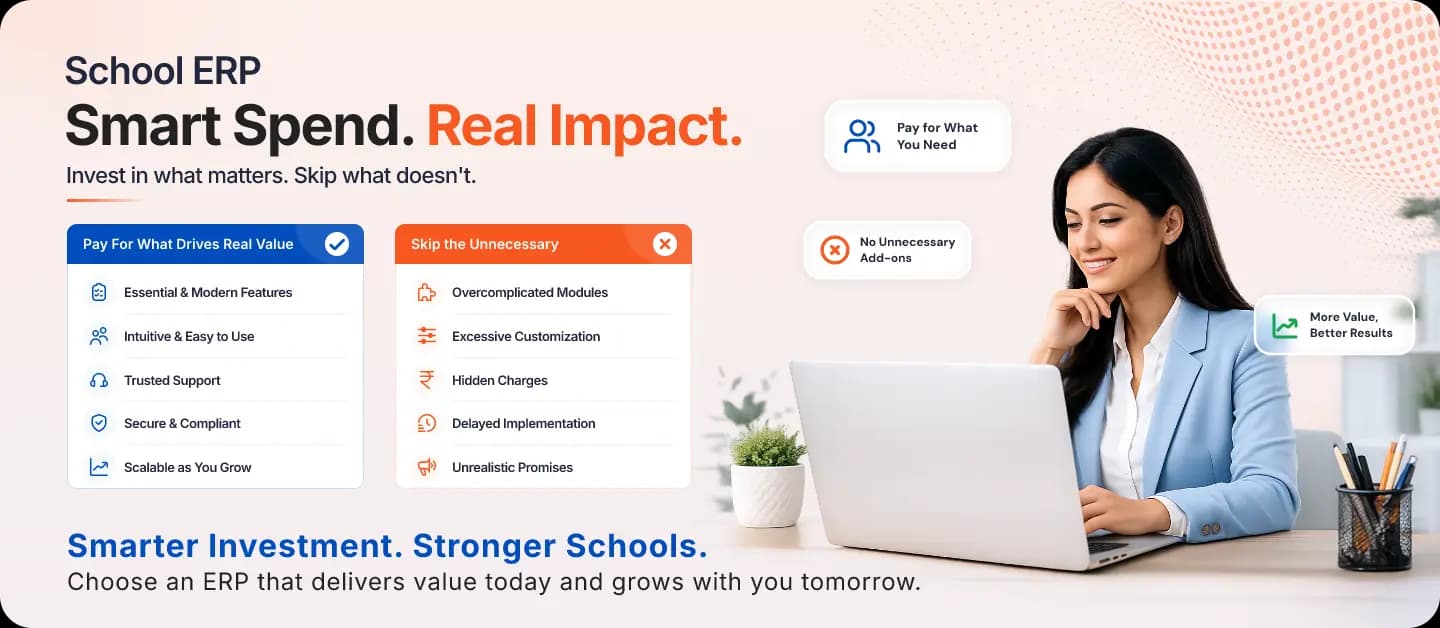
School ERP pricing in India ranges from under ₹100 per student per year to several lakhs annually for enterprise implementations. That range is so wide it's almost meaningless without context.
The real question isn't what the software costs. It's what it costs relative to what your school actually gets out of it. A platform priced at ₹50 per student that solves nothing is more expensive than one priced at ₹150 that genuinely transforms how your school operates.
Here's how to think about school ERP value for money - honestly, and without the sales pitch.
What you should be paying for
-
Comprehensive coverage of your core operations
A school ERP earns its cost when it replaces multiple disconnected tools and manual processes with one integrated system. If your school currently manages admissions in a spreadsheet, attendance in a register, fees in a tally sheet, and communication through WhatsApp - the ERP that replaces all of that is delivering significant value.
The modules that deliver the clearest return are: admissions management, attendance, fee management, examination management, timetable management, and multi-channel parent communication. These are the areas where manual processes cost the most time and generate the most errors.
-
Implementation that doesn't charge extra for setup and training
One of the most common complaints school owners share after ERP implementations is the hidden cost of getting started. The subscription was affordable. The setup fee wasn't disclosed upfront. The training was billed separately. Customisation requests added thousands more.
Genuine value means the cost you're quoted includes the cost of getting your school operational. Setup, data migration, staff training, and early support should be part of what you pay - not surprises after the contract is signed.
-
Support that stays active after go-live
An ERP that's abandoned three months after implementation because the vendor stopped responding is worth nothing - regardless of what it cost. Support is part of the product. The schools that get the most value from a school management system are the ones with a vendor who stays involved, answers questions quickly, and helps the school use the platform more effectively over time.
What you should not be paying for
-
Modules your school will never use
Enterprise school ERP platforms are built to serve institutions of every size and type - large school chains, colleges, coaching institutes, hostels. Their pricing reflects that. Your school ends up paying for hostel management, canteen systems, alumni tracking, and transport GPS - even if none of those apply.
A genuinely affordable school ERP for a small or mid-sized institution is one that's priced for what schools your size actually need. Not for every possible feature that exists in the category.
-
Complexity that requires IT staff to maintain
There's a version of 'comprehensive' that means powerful and genuinely useful. And there's a version that means complicated, dependent on technical staff, and expensive to maintain. Schools without a dedicated IT team should not be choosing the second kind.
If the platform requires IT involvement for basic configuration changes - adding a new class, adjusting a fee structure, generating a new report - the operational cost of using it is higher than the subscription price suggests.
-
Lock-in that prevents you from leaving
Some ERP vendors make it deliberately difficult to export your data if you decide to switch platforms. This is not a feature. It's a trap. Your school's data - student records, fee histories, academic records - belongs to your institution. Any platform that doesn't give it back cleanly if you leave is not a partner. It's a liability.
How to evaluate school ERP value before signing anything
Three questions that cut through the noise:
-
What is the total cost over two years - subscription, setup, training, support, and any likely add-ons?
Which of these modules will my staff actually use within the first three months?
What happens to our data if we decide not to renew?
The answers will tell you more about real value than any feature comparison table.
What does genuine value look like for a growing school?
It looks like a platform that covers every operation your school depends on daily - without charging you for the ones it doesn't. It looks like a vendor who treats implementation and support as part of the relationship, not as optional add-ons. And it looks like pricing that a school with 500 students can sustain without it becoming a financial decision every renewal cycle.
myMschool is priced for growing schools. Transparent pricing, no hidden setup costs, comprehensive coverage of the modules that matter. See what it looks like for your school.